All posts by Rachel

Composting in Chicago

The Climate Reality Project’s Chicago Metro Chapter recently asked me to step up and be the co-leader (with my new pal, Florita) for the new Chicago (as opposed to suburban) Team. Our team has two main areas of activism for the near term – I’ll be taking point on composting, and Florita will be taking point on building decarbonization.

So, if you have any questions, thoughts, or concerns relating to how we can reduce the barriers to composting in Chicago and support a culture of composting, I’d love to hear from you!

Online Workshops, Reading Groups, & Lecture Series

There are so many cool (free!) online workshops, reading groups, and lecture series nowadays! I’ve been taking part in more of them of late, and really getting a lot out of them, so I want to take a moment to say kudos to all the organizers and participants that I’ve been learning with and from (and to give other folks a nudge to join if they are so inclined)!

Check out the following links to some of my recommendations:

Work In Progress Groups

Workshop on Gender and Philosophy (WOGAP)

Animals in Philosophy, Politics, Law and Ethics (APPLE)

Emotion and Society Lab WorksIn-Progress Series (brand new – I’m looking forward to the first session)

Lecture Series

Conceptual Engineering Lecture Series (CELS)

Society for the Study of Ethics and Animals (SSEA) Online Colloquium Series

“Creating Carnists”

Jeremy Fischer and I have once again teamed up to co-write a paper, “Creating Carnists,” which is now forthcoming in Philosophers’ Imprint!

We’re so happy to have placed our second academic collaboration in another open access journal so that money won’t be a barrier for anyone who wants to read it. I’ll paste the abstract below, and if it sparks your interest, there’s no need to wait until the final, copy-edited version is published – feel free to take a look at our penultimate draft.

Abstract: We argue that individual and institutional caregivers have a defeasible moral duty to provide dependent children with plant-based diets and related education. Notably, our three arguments for this claim do not presuppose any general duty of veganism. Instead, they are grounded in widely shared intuitions about children’s interests and caregivers’ responsibilities, as well as recent empirical research relevant to children’s moral development, autonomy development, and physical health. Together, these arguments constitute a strong cumulative case against inculcating in children the dietary practice of regularly eating meat (and other animal products)—a practice we call “carnism.”

Advocacy Groundwork: Manageable Steps Toward Climate-Friendly Investment/Divestment

Many students and teachers interested in sustainability advocate divestment from fossil fuels as a way to defund unsustainable energy practices, take a symbolic stand, and help train new organizers. October’s Philosophers for Sustainability forum, which I’ll be co-leading, will involve thinking through some possibilities and strategies for divestment advocacy:

What strategies are in reach for overworked academics who endorse financial activism but work in settings where most people in power are (currently) indifferent or hostile to institutional divestment? In this forum, I’ll share some ideas from a recent mini-campaign and invite discussion about organizing. We’ll also have time to discuss other sustainability advocacy projects that may feel daunting in scope or low in likelihood of success.

The forum will be held by Zoom on Friday, October 7, 11am-noon ET (eastern USA and Canada time). Email me for the link. We look forward to seeing some of you there!

Book recommendation: Utopia for Realists, by Rutger Bregman

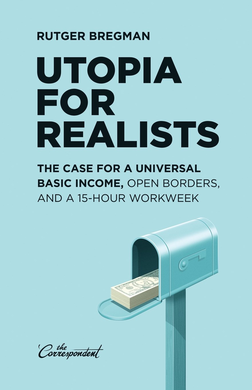
The cover of Utopia for Realists

I love reading books that explicitly encourage us to stretch our imaginations. You don’t have to be an optimist to think that the way we organize the world and live our lives isn’t the best possible way. People with very different views can often agree that things, in general, could be better.

And Rutger Bregman’s Utopia for Realists: The Case for a Universal Basic Income, Open Borders, and a 15-hour Workweek pushes us to consider the possibilities for significant positive change at the social level by reflecting on some changes we’ve already made (and some opportunities that we missed out on). It is a welcome change of pace for me to see someone looking to the future with some excitement, and I’m betting that I wouldn’t be alone in feeling that.

One of the things I liked most about this book is how it brings to our attention various historical events that aren’t as well-known as they probably deserve to be. The author has clearly done his research, but the writing is still quite accessible and conversational. It would be an especially good starting place for folks who haven’t previously given much thought to the specific policies he advocates (universal basic income, shorter workweeks, and open borders).

Game recommendation: Baba Is You

I’m not a big fan of competition, so I’ve never been much of a game player. But recently, I’ve decided to try branching out a bit to explore some collaborative and one-person games. (I already spend lots of time looking at my computer screen, so I have to really want to play a game to make increasing my screen time worth it.)

Enter Baba Is You (available on many different platforms), which stretches your logic brain muscles, since it involves changing the rules while you play in order to make winning possible!

In each level of this simple, 2D game, the protagonist is determined by the initial text on the screen (hence, “Baba Is You”). You can move different objects and words around obstacles and into various configurations, and you can even change the identity of who is “you.” What it takes to complete a level is determined by the phrase “x Is Win.” And since you can take as much time as you like and undo any fatal move, the game allows you to focus all your attention on solving the puzzles, rather than stressing out, which is right up my alley.

Regular game players are better positioned to give more nuanced descriptions of both the game and what makes it unique – here is one more detailed review that does a good job of capturing lots of the things I like about it.

Going to the Pacific APA?

During the Pacific APA business meeting on Thursday, April 14th, from 12:00 to 1:00 p.m., a fellow Philosopher for Sustainability will be introducing a resolution supporting the APA 2+1 campaign.

Since I can’t be there in person, I’m encouraging everyone who can to attend and vote for the resolution. This is a great opportunity to help significantly reduce climate-damaging emissions without expending much time or effort!

We would be so grateful to have your support. In the meantime, I would be happy to field any questions or concerns about the campaign or the other work that our group is doing.

And for folks who can’t go to the meeting and vote, you could always sign our online petition instead, if you haven’t already!

Defense Against Disinformation

Thanks to the Union of Concerned Scientists for the opportunity to attend their two-day “Defense Against Disinformation: Strategic Communication for Advocates” online training!

Poster saying “Stand up for Science: Union of Concerned Scientists”

There was a lot to learn from the presentation and dedicated time to practice putting it into action, so I can see the training being useful both for folks who have already thought a lot about communicating across difference, and also for those who are new to that sort of thing.

So if you have the chance to take the training in the future, I would recommend it!

Conceptual Engineering Online Seminar

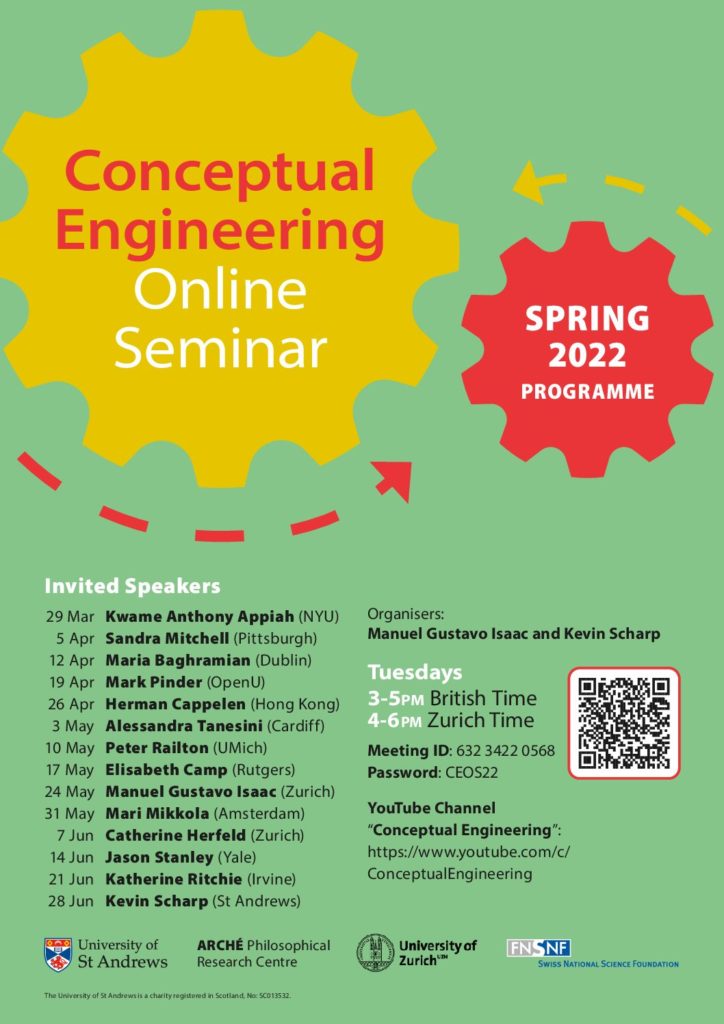
Yesterday was the first session in this spring’s Conceptual Engineering Online Seminar, and the first one that I’ve ever been able to attend live – though I’ve enjoyed watching all the older ones on their YouTube channel since liberating myself from my previous employer.

Thanks to Kwame Anthony Appiah for getting the spring series off to a great start!

The seminar meets every Tuesday at 9:00 a.m. Central time until June 28th and is open to all. (Thanks to the organizers in Europe for not making it any earlier!) See the poster below for the Zoom info.

Philosophers for Sustainability

In my book, philosophy isn’t something you have, but something you do. So philosophers aren’t just thinkers. We are doers.

And there is a lot that we can do, individually and collectively, by strategically using our particular skills, knowledge, and social locations, to help move humanity toward doing a better job of sustaining all the people, other living things, and ecosystems that can be found on this amazing and beautiful planet.

If you’ve already made a habit of choosing the relatively sustainable options in your personal life, one way to level up on your sustainability activism is to join the Philosophers for Sustainability. We’ve got various advocacy teams, workshops, and resources, and we welcome all comers, from casual participants to gung-ho experts and leaders.

Right now, our biggest area of momentum is the APA 2+1 campaign, a plan to shift 1 or 2 of the 3 divisional meetings of the American Philosophical Association each year to an entirely online format, with the in-person meeting(s) rotating between divisions. Implementing this plan would dramatically cut our profession’s greenhouse gas emissions, save money, and make the meetings accessible to a wider range of philosophers.

Please consider signing and sharing the petition, if you aren’t already one of the 689 signatories so far!